

Picking out Tech Stack for Web Development: Basic Tips and Things to Consider
No matter what particular type of product you want to release, the tech stack is among the primary things to consider. Not only the feature set but also the ease of ready product maintenance and its future scalability are determined by the underlying technology.
Tech Stack Definition & Types
To put it simply, the term “web development tech stack” describes the set of instruments used for developing a certain web product – a website or an app. For ease of convenience, they are divided into two large groups – front-end and back-end techs.
Front-End Tech Stack
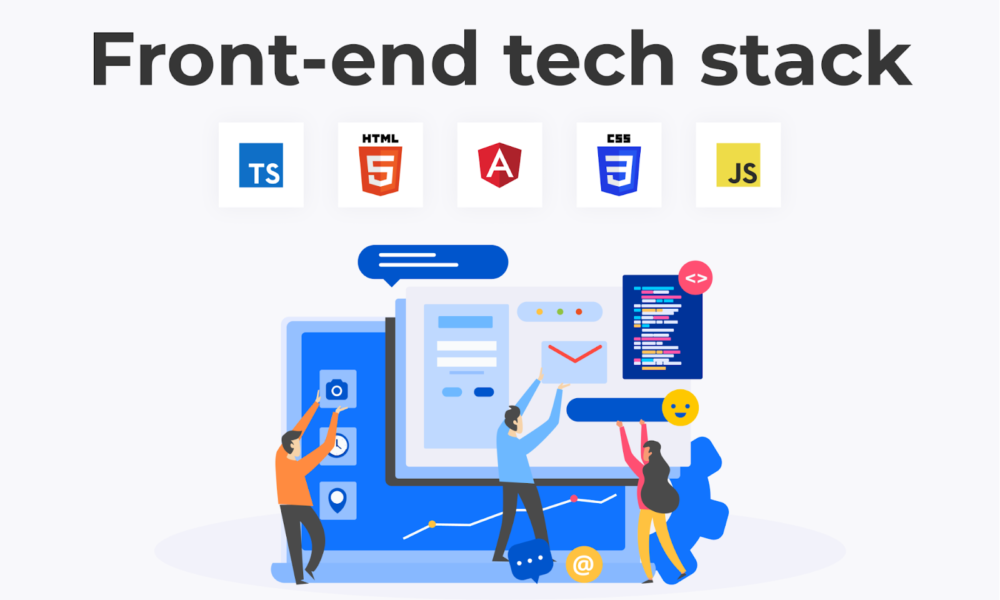
The front-end development is about all visual elements, i.e., everything end-users have to deal with: banners, buttons, graphic elements, etc. So, the front-end tech stack consists of the techs that allow you to create these elements. Just a few examples are HTML, CSS, JavaScript, and SASS.
With that being said, modern interfaces require tools that provide more diversity and flexibility than just basic programming languages. For this reason, the latter is often complemented by various frameworks. For example, some great frameworks for the JS language are React, Angular, Vue, and others. Alternative languages (TypeScript, CoffeeScript, etc.) add flexibility. Popular assembly tools, in their turn, help simplify routine tasks, such as compressing images.
Back-End Tech Stack
Apart from the visual interface, every web app has its inner structure, which is hidden from users’ eyes. However, this architecture is responsible for the correct operation of the whole product, so the importance of back-end development can’t be overestimated.

The key constituent parts of any back-end stack are a server, an app, and a database. Other important components to consider include hosting, an OS, and the type of storage. The adequate selection of programming languages and frameworks is also crucial.
1. Operating system is chosen before developing any website or application. Most frequently selected by developers options are Windows and Linux.
2. Server tools, if chosen correctly, provide smooth operation and quick request processing. Apache and Nginx are worth considering.
3. No website can operate without a database, which is a place where large data massifs are stored. A database keeps and processes all types of figures, numbers, dates, names, and so on. MySQL and PostgreSQL are just a couple of examples of database development tools.
4. Media storage is intended to keep images, videos, and so on. Frequently used tools in this sector are AWS S3, Firebase Storage, etc.
5. Hosting allows you to post your newly written app or a site on the web. Samples of reliable hosting services are Amazon EC2, Nginx, Firebase Hosting, and others.
6. Programming languages are intended for writing a code for the whole “skeleton” of a future website. Some well-known examples are Java, PHP, Python, C#, etc.
7. Frameworks are powerful tools that help expand developers’ possibilities. Laravel, Yii2, Zend are just a few frameworks with excellent functionality.
Realizing what particular technologies will be of use for the development of a web product, you may opt for one of the ready-to-use tech bundles:
- LAMP, which stands for Linux/Apache/MySQL/PHP (Perl). This set combines powerful and flexible tools that allow you to produce a full-featured web app within a limited time.
- Python-Django is not a bad choice for apps’ back-end, though Django tends to be sort of slow.
- .NET is rather a framework than a tech stack, but still, it is worth considering as an additional tool.
How to Select a Tech Stack: Basic Tips
If you are not sure what particular web dev tech stack suits your needs best, follow some essential tips to make the job easier.

1. Rely on your experience. It’s always easier to deal with something familiar, so if your web development team has an impressive experience of using JavaScript, why not consider it as a key option.
2. Specify all the requirements for the future product in advance to see the whole picture. The tech stack choice will largely depend on the app structure. Thus, Angular will work for simple web apps, while JavaScript and .NET are best for complex sites and applications.
3. Keep track of scalability. By making your web product scalable, you are investing in your future. Try to focus on the tools that provide maximum flexibility in terms of further upgrading and improving.
4. Keep up with modern trends. By using only old tried and tested technologies, you are risking becoming outdated soon. Don’t be shy to experiment and keep your options open.
5. Focus on security. When making a list of requirements, double-check everything related to users’ security. Make sure you apply enough resources to it.
6. Anticipate possible risks. Estimate your team’s skills honestly to exclude future issues with the chosen approaches.
7. Stay reasonable and bear in mind that the perfect is an enemy of the good. It makes no sense to replace a time-proven technology with a new one just because the latter has just appeared.
To Sum It Up
For the creation of a good web app or a website, the proper dev tech stack is needed. We hope our tips will help you find the right solution.